B.3.2SL only
Interventions related to injury
Guiding question: How can injuries be prevented, and how are they treated so the athlete returns safely?
Learn it, then try it
Read each idea, work through its activities, then tick it off. 0 of 3 done.
B.3.2.1
Reducing the risk of injury
Injury prevention works in two ways: limiting harmful forces on the body and improving its ability to absorb them. Methods include protective equipment, equipment sized to the user, flexibility training, a proper warm-up and prehabilitation. Learning correct technique and using age-appropriate rules, such as limits on tackling in youth sport, also help.
Match the terms
Key terms
Match each term to its meaning.
Tap a term, then tap its meaning.
Check yourself
Quick check
1.Which summarises how methods of lowering the risk of injury work?
2.A cyclist's head strikes the road in a crash while wearing a padded helmet. How does the padding reduce the peak force on the head?
3.Which is an example of selecting sporting equipment to suit the user's body size?
B.3.2.2
Treating inflammation and healing
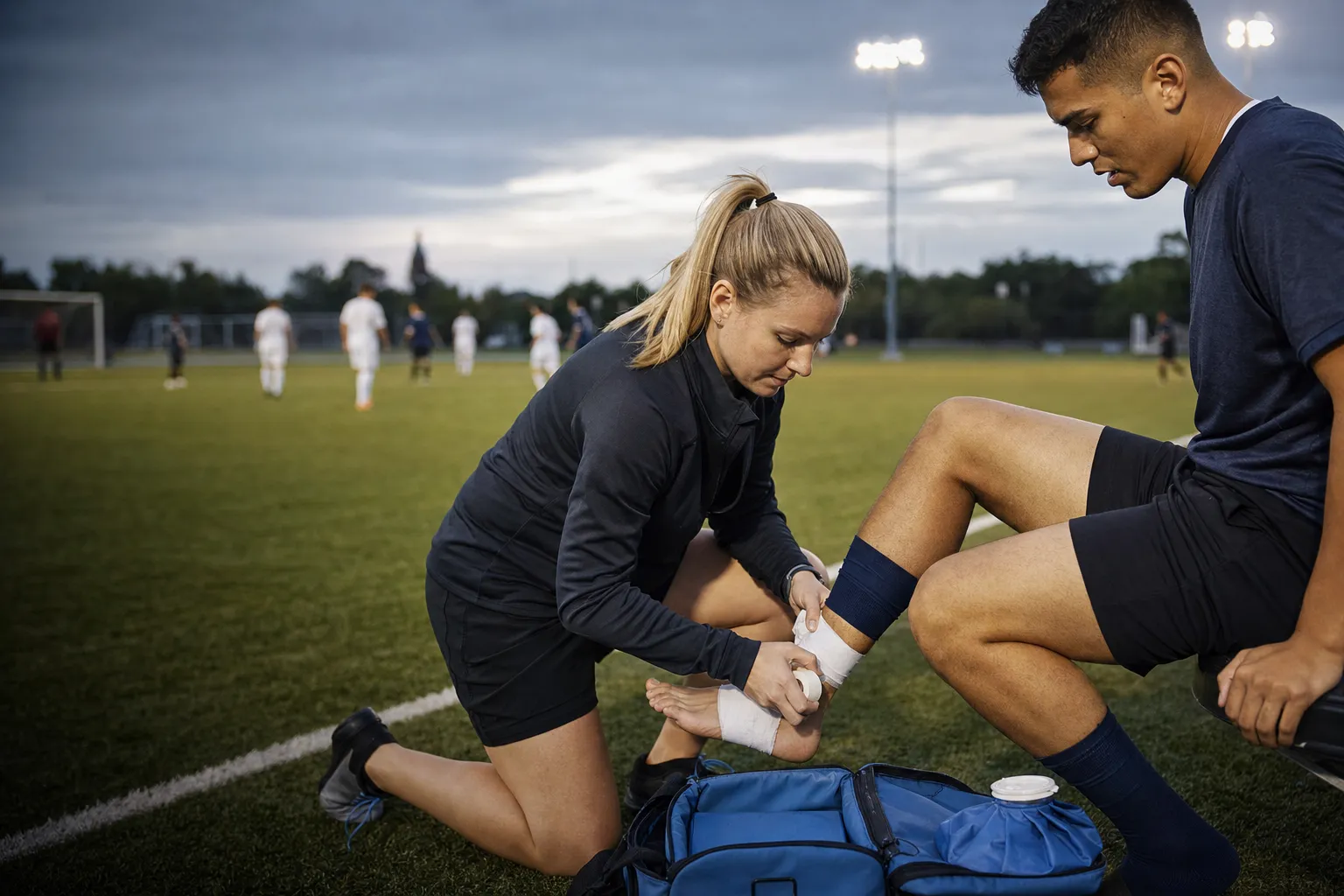
Inflammation causes pain, swelling, heat and redness, but it is also the first stage of healing. Ice, compression, elevation and NSAIDs reduce inflammation and pain, balanced against its healing role. Complete tears or major fractures may need surgery, followed by therapies such as physiotherapy for a safe return.
Match the terms
Key terms
Match each term to its meaning.
Tap a term, then tap its meaning.
Check yourself
Quick check
1.Which set of signs shows that inflammation is present?
2.How does applying ice to a soft tissue injury mainly reduce swelling?
3.A goalkeeper sprains a wrist and is told to keep the hand raised above the level of the heart. How does this help?
B.3.2.3
Concussion recovery
Concussion treatment depends on the individual and the injury, and recovery does not always progress steadily. Returning to daily life, school and then sport happens in stages, with mental and physical demands rising step by step. An athlete moves to the next stage only if any increase in symptoms is mild and brief.
Check yourself
Quick check
1.During a staged return to sport after concussion, an athlete's symptoms return during non-contact training. What should happen next?
2.Two players receive similar knocks to the head in the same match. One is free of symptoms within a week, while the other still has headaches a month later. Which explains this?
3.Which sequence of stages is most appropriate for a return to sport after concussion?