A.1.2SL + HL
Maintaining homeostasis
Guiding question: How does the body keep its internal conditions steady when exercise, heat, cold or altitude push them off balance?
Learn it, then try it
Read each idea, work through its activities, then tick it off. 0 of 2 done.
A.1.2.1
Homeostasis and negative feedback
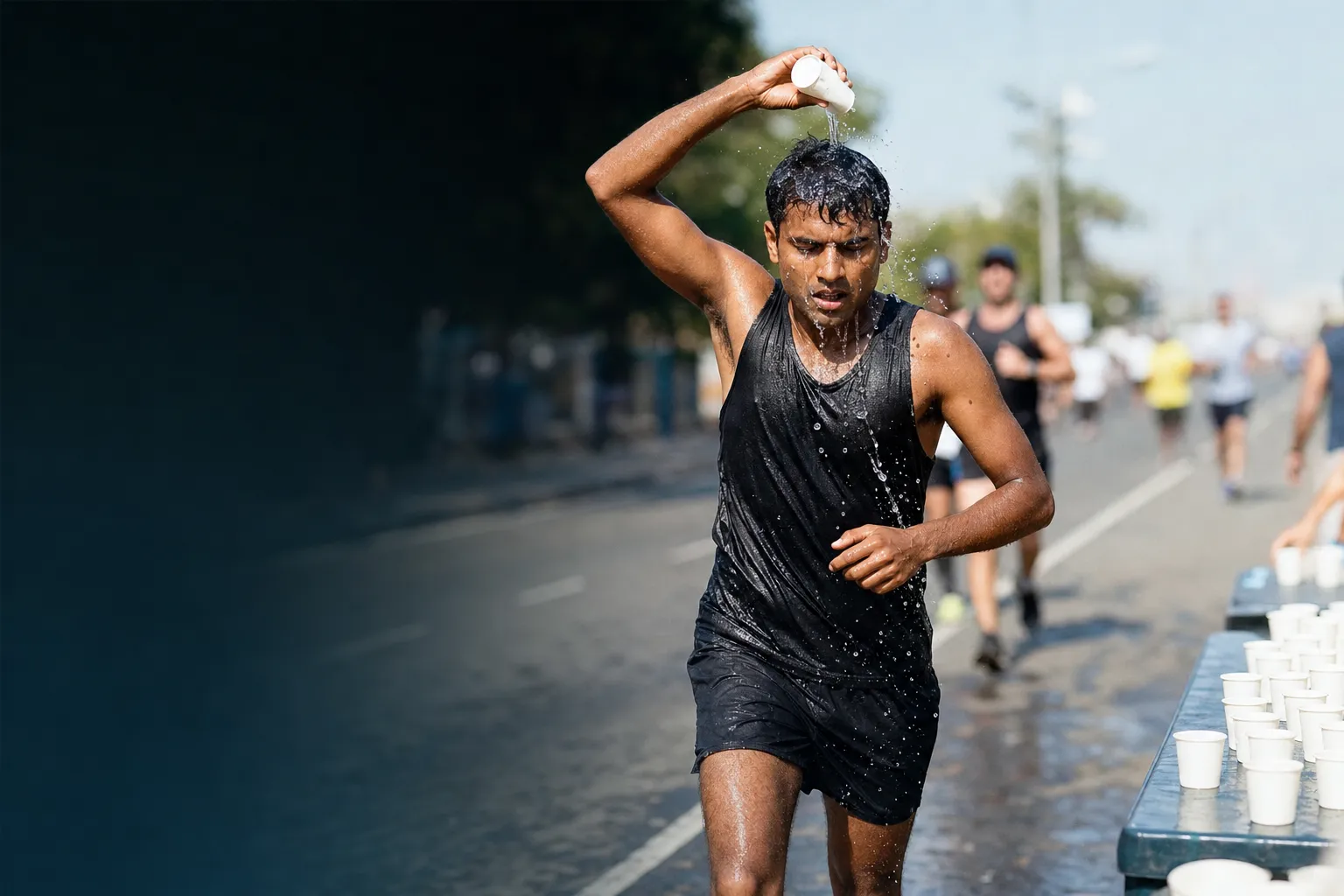
Homeostasis is the self-regulation that keeps the internal environment fairly stable, usually through negative feedback that reverses any change. Chemoreceptors and the respiratory control centre detect rising carbon dioxide and falling pH, so breathing increases to remove carbon dioxide. Heart rate is set intrinsically by the SA node and adjusted extrinsically by nerves and hormones. Sweating, vasodilation, shivering, vasoconstriction and non-shivering thermogenesis hold core temperature near 37 °C. Sex (including hormonal phase), training status, body composition and the environment all affect how well this works. Insulin and glucagon control blood glucose; during exercise insulin release falls while muscles take up more glucose.
Match the terms
Key terms
Match each term to its meaning.
Tap a term, then tap its meaning.
Check yourself
Quick check
1.Which is the correct sequence for excitation of the heart muscle?
2.What regulates the rate and depth of ventilation when an athlete starts to exercise?
3.An increase in carbon dioxide concentration in the blood will primarily lead to:
A.1.2.2 · HL only
Responding to the environment
Heat, humidity and altitude cause short-term responses and, with repeated exposure, longer-term adaptations. The effect on performance depends on the activity: long aerobic events suffer most in heat and at altitude. Short power events can even gain from the thinner air at altitude. Strategies include acclimatisation, altitude training, pre-cooling and planned hydration.
Match the terms
Key terms
Match each term to its meaning.
Tap a term, then tap its meaning.
Check yourself
Quick check
1.Why does an endurance athlete's maximal aerobic capacity fall when exercising at 2,500 m above sea level?
2.Which event would be most likely to benefit from being held at a venue 2,200 m above sea level?
3.A rower lives and trains at altitude for several weeks. Which adaptation would be expected?
Practise this topic
Self-marking exam-style questions with Guide me hints and full mark schemes.