A.2.3SL + HL
Energy systems
Guiding question: How does the body make enough ATP for a ten-second sprint, a two-minute race and a three-hour marathon?
Learn it, then try it
Read each idea, work through its activities, then tick it off. 0 of 4 done.
A.2.3.1
The three energy systems
The phosphagen, glycolytic and oxidative systems resynthesise ATP, each with its own fuels, speed, capacity and recovery time. The energy continuum shows how all three contribute, depending on the activity. At rest and in long submaximal exercise the oxidative system dominates; short, intense efforts and sudden surges rely mainly on anaerobic systems.
Match the terms
Key terms
Match each term to its meaning.
Tap a term, then tap its meaning.
Check yourself
Quick check
1.Which fuel supplies most of the energy during prolonged low-intensity exercise?
2.Which energy system supplies most of the ATP during a maximal 30 m sprint?
3.Which fuel does the phosphagen system use to resynthesise ATP?
A.2.3.2
Maximal oxygen consumption (VO2 max)
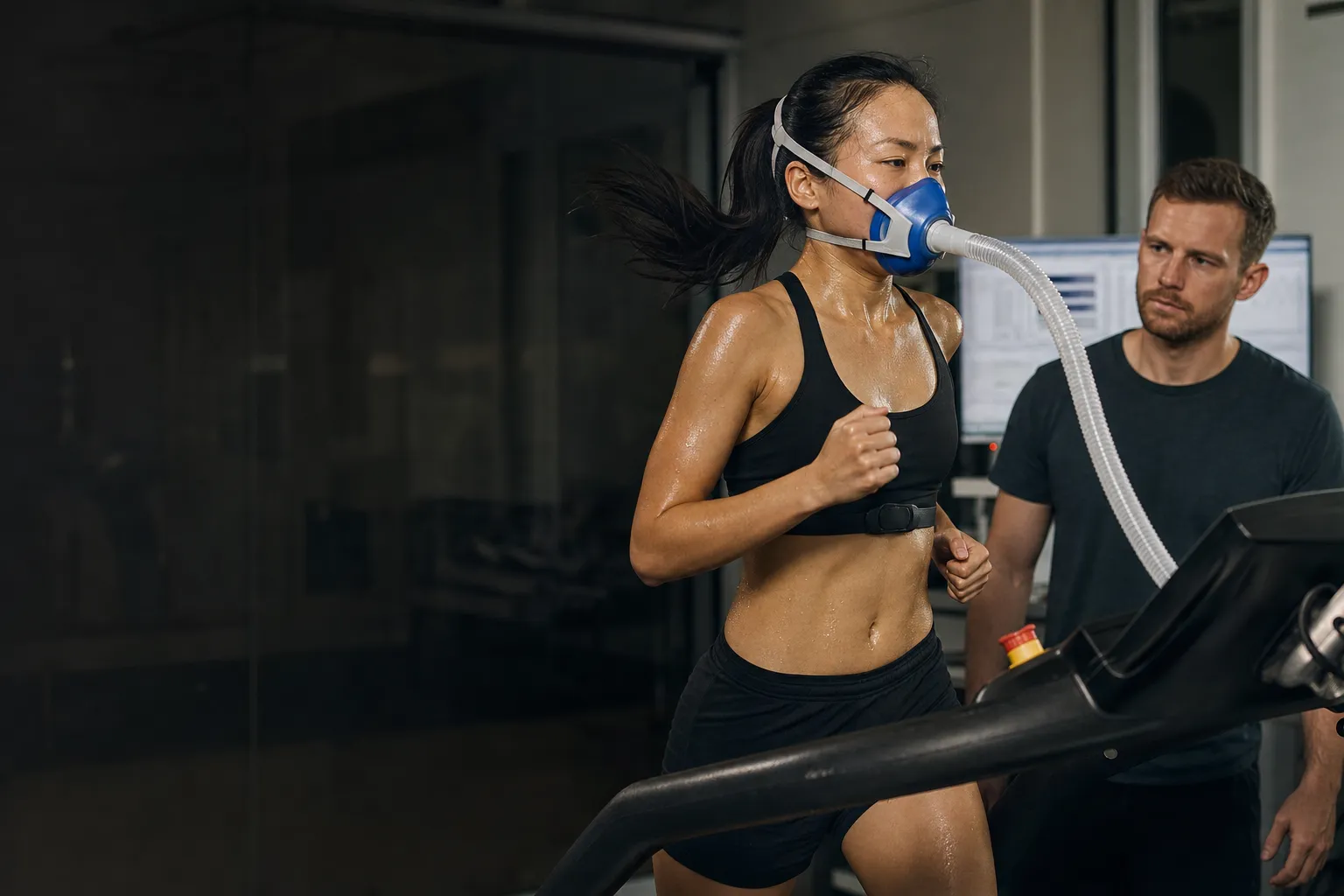
VO2 max is the highest rate at which the body can take in, transport and use oxygen. It varies with age, sex, body composition, lifestyle and training status. A high VO2 max helps endurance athletes, but so does an economical technique, such as efficient running.
Check yourself
Quick check
1.Which can improve running economy? I. Improved technique II. Less unnecessary movement III. Higher oxygen consumption at a given speed
2.Which is the best definition of VO₂ max?
3.Runner P and runner Q both have a VO₂ max of 70 ml kg⁻¹ min⁻¹. At a speed of 16 km h⁻¹, P uses 48 ml kg⁻¹ min⁻¹ of oxygen and Q uses 54 ml kg⁻¹ min⁻¹. Which conclusion is best supported?
A.2.3.3 · HL only
The lactate inflection point
Lactate is produced and removed all the time, even at rest. As intensity rises, production eventually outstrips removal and blood lactate starts to climb steeply. This turning point is the lactate inflection point; above it, exercise can be kept up for far less time.
Check yourself
Quick check
1.Which statement describes the lactate inflection point?
2.Which statement best defines the lactate inflection point?
3.A triathlete's blood lactate is measured at the end of each stage of a treadmill test: 10 km h⁻¹, 1.0 mmol L⁻¹; 12 km h⁻¹, 1.1 mmol L⁻¹; 14 km h⁻¹, 1.2 mmol L⁻¹; 16 km h⁻¹, 1.3 mmol L⁻¹; 18 km h⁻¹, 3.4 mmol L⁻¹; 20 km h⁻¹, 6.8 mmol L⁻¹. Between which speeds is the lactate inflection point?
A.2.3.4 · HL only
EPOC
After exercise, oxygen uptake stays above resting level while the body restores its resting state. The size of this EPOC depends on the oxygen deficit built up during exercise, especially at the start. Its fast component restores phosphocreatine and reloads myoglobin; its slow component clears lactate and returns temperature, heart rate and breathing to rest.
Match the terms
Key terms
Match each term to its meaning.
Tap a term, then tap its meaning.
Check yourself
Quick check
1.What causes the oxygen deficit at the start of exercise?
2.Which process is a key part of EPOC?
3.Which statements describe EPOC? I. Restoration of ATP and phosphocreatine stores II. Removal of lactate III. Oxygen consumption above resting levels after exercise
Practise this topic
Self-marking exam-style questions with Guide me hints and full mark schemes.