B.2.1SL + HL
Newton's laws of motion
Guiding question: How do Newton's laws explain how athletes start, stop, change direction and spin?
Learn it, then try it
Read each idea, work through its activities, then tick it off. 0 of 4 done.
B.2.1.1
Linear and angular motion
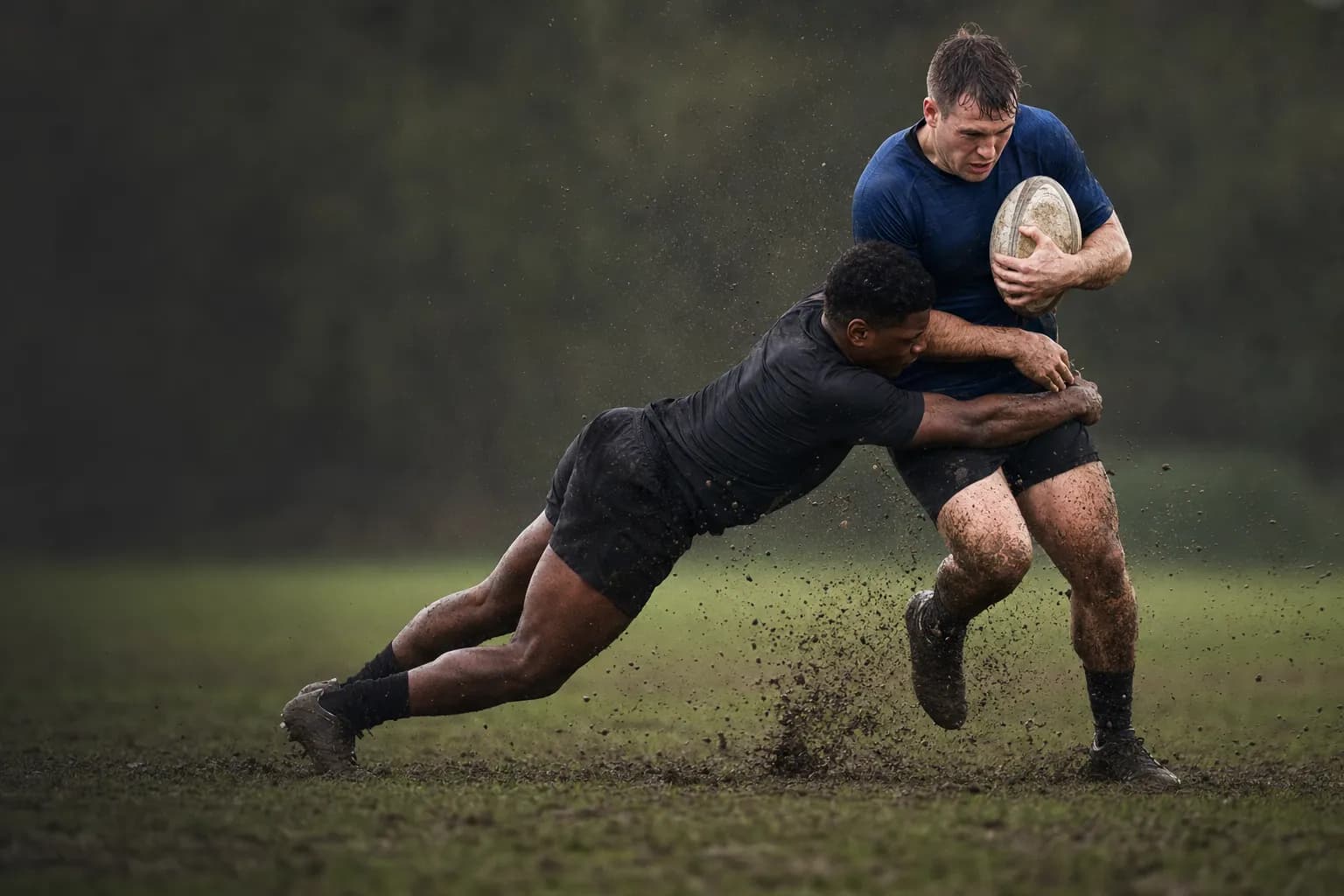
Speed, velocity and acceleration describe motion, and the resultant of all the forces acting decides how a body moves (F = ma). A larger impulse produces a larger change in momentum, and the direction of the impulse sets the direction of motion. Summing joint forces in sequence, from large to small segments, maximises the force or speed produced. Stability depends on centre of mass height, base of support size, line of gravity position and mass. An eccentric force causes rotation, and angular momentum is conserved when no further eccentric force acts, as in flight.
Match the terms
Key terms
Match each term to its meaning.
Tap a term, then tap its meaning.
Check yourself
Quick check
1.In an ice hockey game, a player hits a stationary puck with a force of 80 newtons (N). According to Newton's second law of motion, what will happen to the puck?
2.Which would cause a change to the hammer’s moment of inertia? I. Decrease the radius by shortening the chain on the hammer. II. Increase the mass of the hammer. III. Increase the radius by lengthening the chain on the hammer.
3.A golfer wants to increase the force applied to their golf ball to make it travel further. Assuming the ball will be hit with the same acceleration each time, which golf club should they use?
B.2.1.2 · HL only
Collisions and coefficient of restitution
In a collision, each body's change in momentum equals the impulse (force × time) it receives. The coefficient of restitution, from 0 to 1, shows how elastic a collision is. It equals the relative velocity of separation divided by the relative velocity of approach.
Check yourself
Quick check
1.A ball hits a stationary wall at 20 m s⁻¹ and rebounds at 12 m s⁻¹. Using the data booklet, what is the coefficient of restitution?
2.Which would increase the coefficient of restitution of a squash ball?
3.A 0.06 kg tennis ball reaches a racket at 20 m s⁻¹ and leaves in the opposite direction at 30 m s⁻¹. What is the size of the ball's change in momentum?
B.2.1.3 · HL only
Friction
Friction opposes sliding between surfaces. Static friction can rise only to a limit: the static coefficient × the normal reaction force. During sliding, friction equals the dynamic coefficient × the normal reaction force. The static coefficient is usually larger, and both vary with the two materials touching. Athletes increase friction with spikes or studs and reduce it by waxing skis or sweeping in curling.
Check yourself
Quick check
1.Which describes the coefficient of friction
2.For the same two surfaces in contact, how does the coefficient of static friction usually compare with the coefficient of dynamic friction?
3.A curling stone of mass 19 kg slides across the ice. The coefficient of dynamic friction is 0.02. Using the data booklet and g = 9.81 m s⁻², what is the friction force on the stone?
B.2.1.4 · HL only
Work, energy and power
Work equals force × distance moved in the direction of the force, measured in joules. Doing work transforms energy, for example chemical energy into kinetic energy. Power equals work ÷ time, measured in watts; it shows intensity and can be raised by better technique and equipment.
Check yourself
Quick check
1.A weightlifter raises a 100 kg barbell vertically through 1.5 m in 0.75 s. Using the data booklet and g = 9.81 m s⁻², what is the mean power output on the bar?
2.In a stair-climb test, students P and Q each do 2400 J of work. Student P takes 4.0 s and student Q takes 6.0 s. Which statement is correct?
3.A kayaker paddles hard during a race. Which statements about work and power are correct? I. Work is done when a force moves its point of application through a distance in the direction of the force. II. Doing work creates new energy in the kayaker's muscles. III. Doing the same work in less time means a greater power output.
Practise this topic
Self-marking exam-style questions with Guide me hints and full mark schemes.
Links to other topics
- B.2.2Where should sport draw the line between clever equipment and unfair advantage, as with heated bobsleigh runners or sharkskin swimsuits?