B.2.2SL + HL
Fluid mechanics
Guiding question: Why do a javelin, a golf ball and a swimmer each move so differently through air or water?
Learn it, then try it
Read each idea, work through its activities, then tick it off. 0 of 3 done.
B.2.2.1
Projectile motion
A projectile's flight path depends mainly on its speed and angle of release. Height of release relative to landing also matters: releasing above the landing point makes the best angle less than 45°. Objects with a high weight to air resistance ratio, such as a shot, follow a near-parabolic path, while a shuttlecock's path is asymmetric.
Match the terms
Key terms
Match each term to its meaning.
Tap a term, then tap its meaning.
Check yourself
Quick check
1.At the start of a race, a swimmer dives off a raised starting block rather than from the side of the pool. With the same take-off speed and angle, how does the block affect the horizontal distance travelled before entering the water?
2.A shot put is released with air resistance negligible. Which of the following does not affect its flight path?
3.Which factors mainly determine the flight path of a projectile?
B.2.2.2 · HL only
Environmental conditions
Temperature, humidity, air pressure and altitude change air density, which changes the drag and lift on an object. Thinner air at altitude reduces drag, helping sprinters and jumpers, although discus and javelin throwers also lose some lift. Wind can help or hinder motion, and salt water is denser than fresh water, so swimmers float more easily.
Check yourself
Quick check
1.Sprint times are often slightly faster at venues about 2200 m above sea level. Which explains this?
2.A kayaker paddles from a freshwater river out into the sea. How does the kayak sit in the water?
3.Under which conditions would a golf ball experience the least air resistance?
B.2.2.3 · HL only
Buoyancy, lift and drag
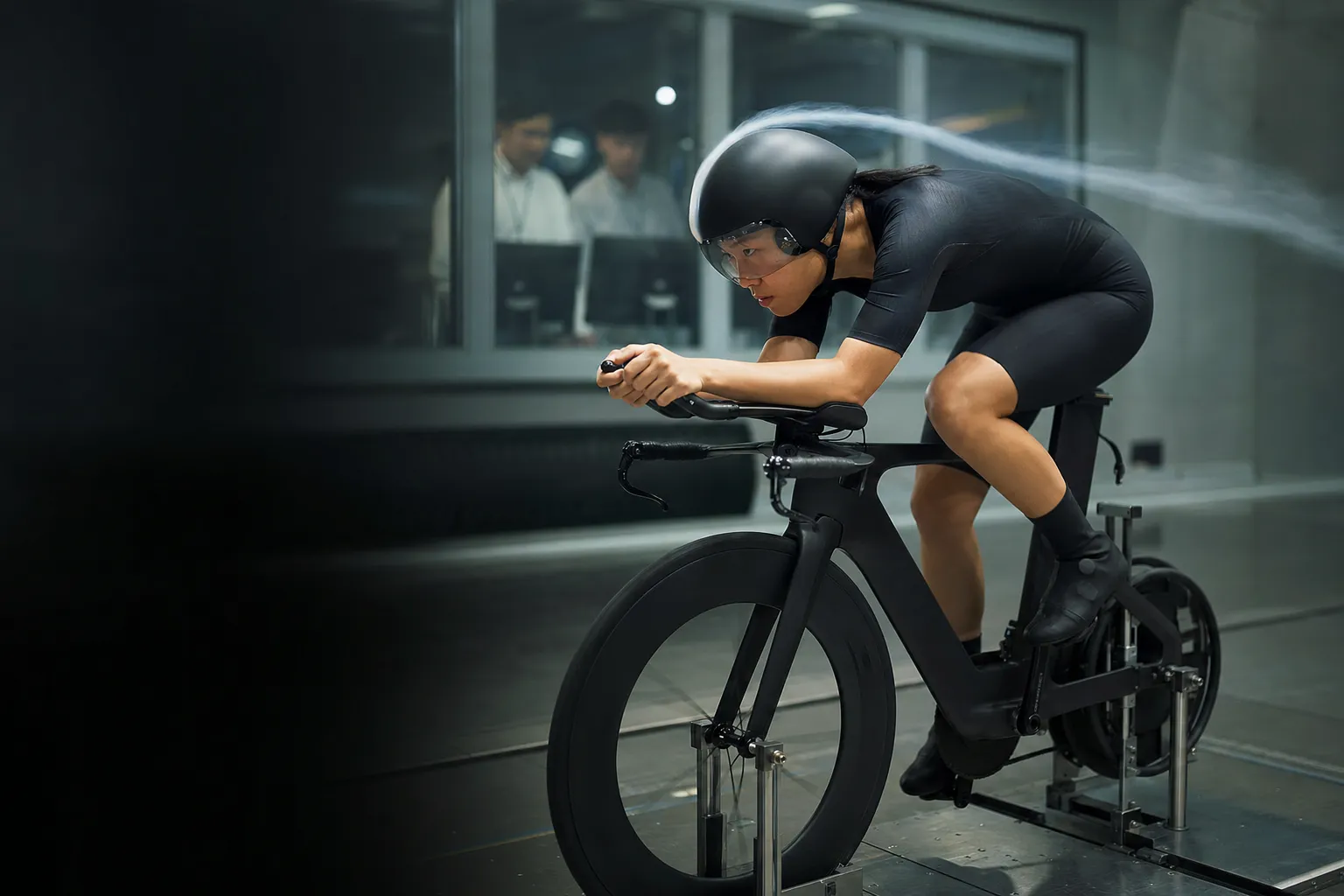
A body in a fluid feels an upthrust equal to the weight of fluid it displaces, so denser fluids give more buoyancy. Surface, form and wave drag can all be reduced by streamlining, smooth suits or shaving, or by changing the environment. Lift comes from Bernoulli's principle and the angle of attack, while spin causes the Magnus effect. Rules sometimes limit equipment that exploits these effects, which raises ethical questions.
Match the terms
Key terms
Match each term to its meaning.
Tap a term, then tap its meaning.
Check yourself
Quick check
1.Which statement describes form drag?
2.Which type of drag is caused by friction between a fluid and the surface of a moving body?
3.Which describes Bernoulli's principle?
Practise this topic
Self-marking exam-style questions with Guide me hints and full mark schemes.
Links to other topics
- A.1.3Could a parachute, sled or water resistance be used to make training harder in a useful way?