B.1.1SL + HL
Anatomical position, planes and movement
Guiding question: How do coaches and scientists describe any movement of the body clearly and without confusion?
Learn it, then try it
Read each idea, work through its activities, then tick it off. 0 of 3 done.
B.1.1.1
Axial and appendicular skeleton
The axial skeleton (skull, vertebral column, ribs and sternum) protects vital organs and supports the trunk. The appendicular skeleton (limbs plus the shoulder and pelvic girdles) is mainly for movement. Terms such as superior, proximal, medial and anterior describe where one body part sits relative to another.
Match the terms
Key terms
Match each term to its meaning.
Tap a term, then tap its meaning.
Check yourself
Quick check
1.Which are functions of the skeletal system? I. Protecting vital organs II. Storing minerals such as calcium III. Carrying out gas exchange
2.Which group contains only bones of the axial skeleton?
3.Which is the primary function of the appendicular skeleton?
B.1.1.2
Planes, axes and terms of movement
Movements take place in the sagittal, frontal and transverse planes, each turning about the axis at right angles to that plane. Flexion and extension usually occur in the sagittal plane about the frontal axis. Abduction and adduction usually occur in the frontal plane about the sagittal axis. Rotation, and horizontal flexion and extension, occur in the transverse plane about the longitudinal axis. Specific terms, such as dorsiflexion, inversion and circumduction, name each joint action.
Match the terms
Key terms
Match each term to its meaning.
Tap a term, then tap its meaning.
Check yourself
Quick check
1.A volleyball player bends the knees to get ready for a block jump. Which describes the movement at the knee?
2.In which plane, and about which axis, do abduction and adduction of the hip usually occur?
3.A figure skater spins on the spot on one skate with the arms held in. In which plane, and about which axis, is the skater rotating?
B.1.1.3 · HL only
Anthropometry and ergonomics
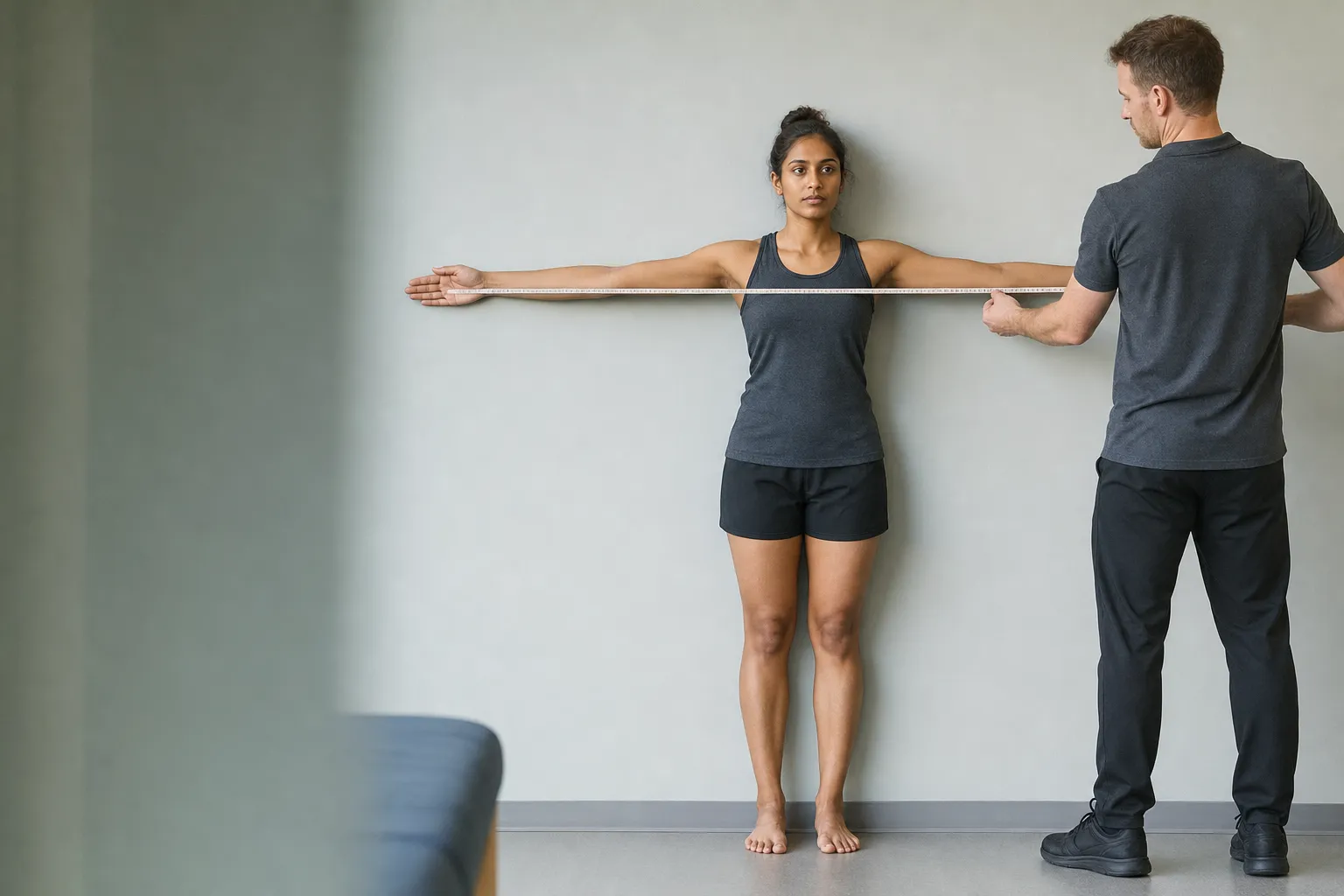
Anthropometry measures the lengths, girths and proportions of body segments. Manufacturers draw on large collections of these measurements when sizing and shaping items such as bikes, helmets and seats. Ergonomics shapes equipment around the user's body, so they can move more efficiently and comfortably.
Check yourself
Quick check
1.How can anthropometric data influence the use of sports equipment in tennis for a child?
2.Which best describes anthropometry?
3.A bicycle manufacturer uses a database of leg lengths from thousands of riders to choose its range of frame sizes. What is the main benefit of this?
Practise this topic
Self-marking exam-style questions with Guide me hints and full mark schemes.