C.4.2SL + HL
Coping
Guiding question: How do athletes deal with stress, and which coping strategies work best in different situations?
Learn it, then try it
Read each idea, work through its activities, then tick it off. 0 of 3 done.
C.4.2.1
Stressors and coping strategies
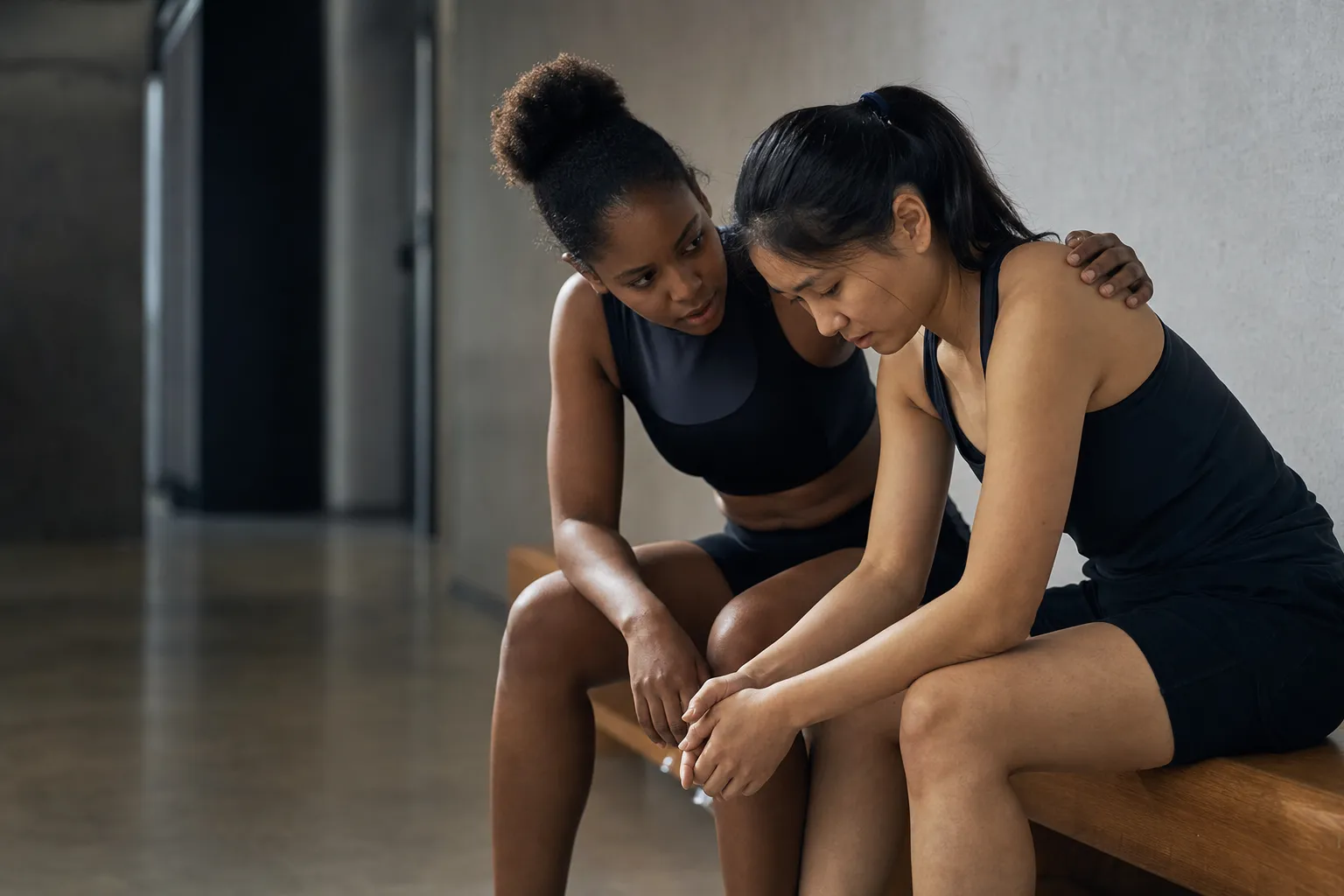
Stressors are demands that cause psychological strain, which may be welcome, like a big opportunity, or unwelcome, like fear of losing. Coping strategies are problem focused (change the stressor), emotion focused (manage the feelings) or avoidance focused (move away from it). Self-talk and relaxation, which helps control heart rate, are simple techniques.
Match the terms
Key terms
Match each term to its meaning.
Tap a term, then tap its meaning.
Check yourself
Quick check
1.Self-talk is best described as
2.Problem-focused coping strategies are strategies that
3.A marathon runner uses slow, deep breathing on the start line to calm her nerves about the race. Which category of coping strategy is this?
C.4.2.2 · HL only
Controllable and uncontrollable stressors
Some stressors can be changed by the athlete and some cannot. Tackling the problem directly suits stressors they can control, such as poor preparation. Managing emotions suits stressors outside their control, such as the weather.
Check yourself
Quick check
1.Which is an example of a controllable stressor for a road cyclist?
2.Which type of coping is most effective for an uncontrollable stressor?
3.Two weeks before a gala, a swimmer is anxious about a weak tumble turn. Which is the most effective coping approach?
C.4.2.3 · HL only
Which strategies work for athletes
No single strategy suits every athlete or situation, but seeking support from others tends to be the most effective. Relaxation, mental imagery, logical analysis, effort expenditure and thought control are also widely used with success. Distraction helps briefly but not with reaching goals, while disengaging, venting and self-blame are maladaptive.
Match the terms
Key terms
Match each term to its meaning.
Tap a term, then tap its meaning.
Check yourself
Quick check
1.Which is a maladaptive coping strategy?
2.Which type of coping strategy has research shown to be the most effective for athletes?
3.After a fall on vault, a gymnast asks her coach for technical advice on correcting the fault. That evening she phones her sister for comfort. How should these two examples of seeking support be classified?
Practise this topic
Self-marking exam-style questions with Guide me hints and full mark schemes.
Links to other topics
- C.1.1, C.1.2Is a conscientious or mentally tough athlete more likely to tackle stress head-on?
- A.1.2How could heart rate, cortisol or skin conductance be used to track an athlete's stress?
- A.1.1, A.3.1How might coping well improve the quality of an athlete's movement?